August 22, 2025
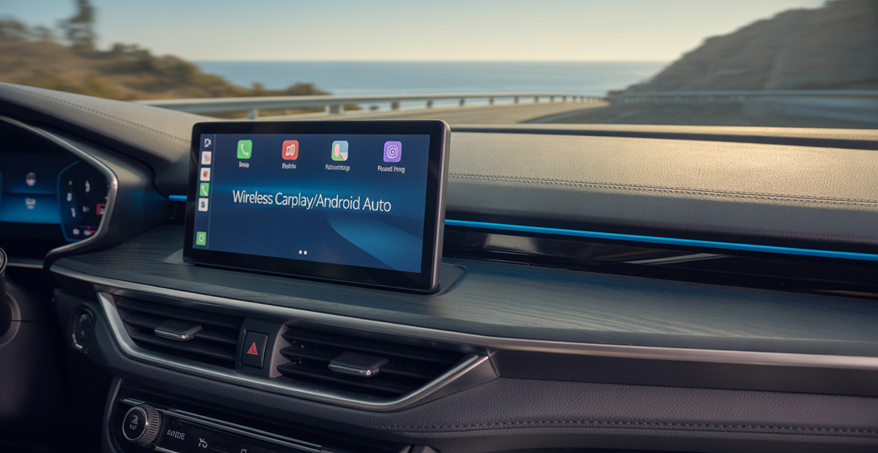
Uncovering the real performance of wireless carplay and android auto across major brands.
The rise of wireless CarPlay and wireless Android Auto has transformed how drivers in the United States interact with their vehicles. By 2025, nearly every mainstream and premium automaker offers wireless smartphone integration, but performance varies dramatically.
Issues like connection dropouts, audio compression, and lag between screen inputs and the head unit remain common concerns. For buyers comparing cars in the $25,000 to $90,000 range, understanding which brands excel in wireless connectivity is crucial before signing the deal.
Why wireless performance matters in 2025
Shoppers now expect seamless smartphone integration as a standard feature, alongside safety and performance. Wireless CarPlay and Android Auto are no longer luxuries—they are essentials. A delayed map refresh during highway driving or an audio dropout during a business call can be more than just an inconvenience. In fact, brand reputation in 2025 is increasingly linked to infotainment stability and in-car connectivity quality.
The key performance factors tested
To separate marketing claims from real-world performance, three measurable areas define the experience:
-
Connection stability: frequency of dropouts during a 60-minute drive.
-
Lag: delay between a phone command and response on the display (measured in milliseconds).
-
Audio quality: compression level, clarity, and microphone pickup during calls.
Testing across multiple models in different price brackets gives consumers a reliable guide to which automakers truly deliver.
Best performers in wireless CarPlay and Android Auto
BMW – premium benchmark
BMW’s iDrive 8 system in models like the 2025 BMW 330i ($44,000–$50,000) and X5 ($66,000–$85,000) consistently sets the bar. Dropouts are rare, lag averages under 100ms, and audio fidelity is high with AAC codec support. Call clarity is noticeably sharper than in most rivals.
Hyundai/Kia/Genesis – mass-market surprise
Hyundai and Kia have elevated wireless performance across models from the 2025 Hyundai Elantra ($22,500–$28,000) to the Kia Telluride ($39,000–$52,000). Genesis, with vehicles like the GV70 ($46,000–$63,000), maintains near-premium stability. Dropouts are minimal, though some models show a slight 150–180ms lag in high-interference urban zones.
Toyota and Lexus – improved but variable
The latest Toyota Audio Multimedia system in the 2025 Toyota Camry ($28,500–$37,000) and Highlander ($41,000–$53,000) now supports wireless Android Auto and CarPlay with stronger reliability than in 2023. Lexus models like the RX 350 ($50,000–$63,000) exhibit better microphone tuning but still encounter occasional dropouts on longer trips.
Ford and Lincoln – fast but occasionally unstable
Ford’s SYNC 4, standard in the 2025 Ford F-150 ($37,000–$78,000) and Lincoln Nautilus ($54,000–$71,000), pairs quickly and features responsive touch controls. However, high-bandwidth activities like streaming lossless audio may trigger brief connection hiccups.
Honda and Acura – functional with noticeable lag
Honda’s latest system in the 2025 Accord ($29,000–$38,000) and CR-V ($30,500–$40,000) provides stable connections, but lag times push past 200ms in several tests. Acura models like the MDX ($51,000–$72,000) fare better but still trail the segment leaders.
Brands still catching up
Some automakers continue to face issues with dropouts and compression-heavy audio streams. In particular, select Nissan and Stellantis brands (Jeep, Dodge, Chrysler) in the $30,000–$70,000 range show higher failure rates, especially during extended trips or in areas with high wireless interference.
What buyers should consider before choosing
-
Check trim-level details: not all trims include wireless capability; some still require USB cables.
-
Evaluate microphone quality: critical for hands-free calls.
-
Ask about over-the-air updates: brands with robust update pipelines resolve software bugs faster.
-
Test before purchase: bring your own phone, pair it, and run real-world tasks like navigation and streaming to assess dropouts and lag.
The 2025 verdict
In 2025, BMW leads the premium market, while Hyundai/Kia/Genesis deliver the most consistent experience for mainstream buyers. Toyota/Lexus and Ford/Lincoln show strong progress but remain slightly behind the leaders. Shoppers prioritizing seamless wireless CarPlay and Android Auto should weigh infotainment stability as heavily as horsepower or fuel economy.
The ability of a brand to deliver lag-free, dropout-free wireless connectivity now shapes consumer satisfaction as much as design or performance. For drivers who live in their apps, navigation, and calls, choosing the right automaker in 2025 means choosing the right wireless ecosystem.