May 5, 2025
Learn how to outsmart hackers and keep your smart car safe on the road.
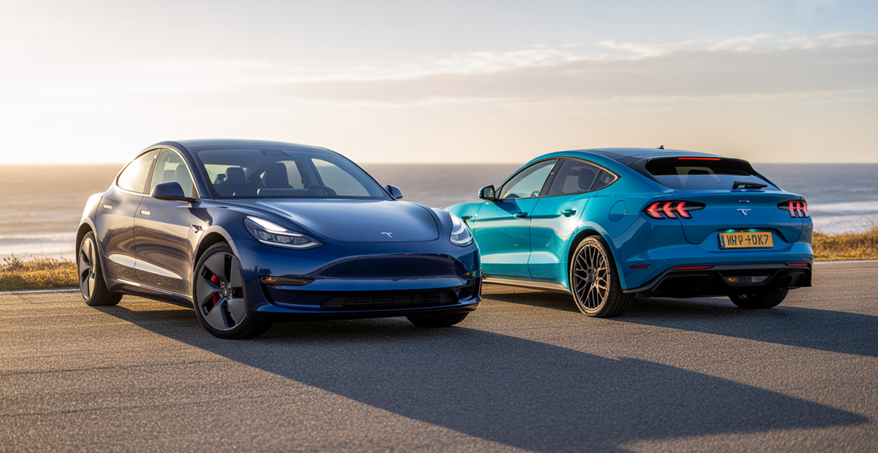
In 2025, connected cars are no longer futuristic concepts—they are the present. With vehicles like the Tesla Model 3 (starting at $38,990) and the 2025 Ford Mustang Mach-E (starting at $41,890) offering advanced connectivity, over-the-air updates, and semi-autonomous features, the convenience is unmatched. But these advancements come with a hidden cost: exposure to cybersecurity threats that can compromise your data, your safety, and even control of the vehicle.
This guide provides a comprehensive, practical approach to protecting your connected car—especially Teslas and Fords—from malicious cyber activity.
Why connected cars are a prime target
Modern vehicles are effectively rolling computers, with dozens of Electronic Control Units (ECUs), Wi-Fi and Bluetooth connectivity, GPS, mobile apps, and even external APIs. Tesla and Ford, among the most connected brands, lead the industry in digital innovation—but also draw increased attention from hackers.
Primary entry points for cyberattacks:
-
Compromised mobile apps: Attackers can clone or infiltrate companion apps like the Tesla app or FordPass to unlock doors, start vehicles, or track user movement.
-
Wi-Fi and Bluetooth vulnerabilities: Open wireless channels can be exploited if not encrypted or updated properly.
-
Over-the-air (OTA) updates: While efficient, OTA systems can be hijacked if not adequately secured, leading to malware injection.
-
Public charging stations: These can act as digital “Trojan horses” where attackers gain access through USB or network vulnerabilities.
-
Vehicle-to-everything (V2X) communication: Newer Fords and Teslas interact with infrastructure and other vehicles—another vector for attack.
The real cost of a hack
In 2022, researchers demonstrated the ability to remotely control Teslas via vulnerabilities in third-party apps. In 2023, white-hat hackers exploited the Mach-E’s modem, granting access to real-time vehicle data. By 2025, these threats have only grown more sophisticated.
What could a hacker do?
-
Disable critical safety systems
-
Track your vehicle’s location in real time
-
Unlock and drive away your car
-
Steal personal data, including home addresses and charging patterns
For vehicles priced between $39,000 and $75,000, the stakes are high—not just financially, but personally.
How Tesla and Ford are responding in 2025
Tesla has continued to harden its systems by:
-
Isolating infotainment from driving controls
-
Adding end-to-end encryption for app interactions
-
Requiring multi-factor authentication (MFA) on all accounts
Ford, on the other hand, has overhauled its Ford SYNC platform and BlueCruise system:
-
Integrating hardware-based security modules
-
Utilizing behavioral anomaly detection
-
Partnering with ethical hacking firms for proactive defense
While these measures are critical, owners also play a key role in cybersecurity defense.
Best practices for owners: Protecting your Tesla or Ford
To keep your connected car secure in 2025, follow these actionable steps:
-
Use strong, unique passwords for all accounts, and enable multi-factor authentication on Tesla or Ford apps.
-
Update firmware regularly—never delay OTA updates from verified manufacturer channels.
-
Avoid connecting to public or unsecured Wi-Fi networks, especially near charging stations or parking garages.
-
Never plug random USB devices into your car’s ports; USB injection is a known attack vector.
-
Review and limit third-party app permissions that connect to your vehicle; avoid using unofficial apps.
-
Monitor your app activity log weekly to detect any unauthorized access attempts.
-
For added protection, consider installing a personal firewall dongle or OBD-II intrusion detection system (available from $150–$400).
-
Disable Bluetooth and Wi-Fi when not in use, particularly if parked for long periods.
Bonus: Tools worth the investment
-
TeslaMate (open-source): Monitor API access and logs in real time
-
Firewalla Gold SE: Offers robust network segmentation, priced around $499
-
CAN Bus Guardian by AutoGuard: Prevents unauthorized commands via the diagnostic port ($350–$500 installed)
Why awareness equals protection
Cybersecurity isn’t optional—it’s an essential part of owning a connected car. As vehicles continue to evolve into software-defined platforms, understanding digital threats and defenses becomes just as important as changing your oil or rotating your tires.
Tesla and Ford may build the future of mobility, but it’s up to drivers to make sure they’re not driving into a digital trap.